While deep geothermal power plants harness high-enthalpy volcanic steam or engineered reservoirs kilometers below the earth’s crust to generate electricity, the upper 100 to 250 meters of the earth’s subsurface represents a colossal, low-temperature thermal capacitor. At shallow depths below the seasonal thermal penetration depth (typically 10 to 15 meters), the ground maintains an extraordinarily stable, constant temperature year-round—roughly equal to the annual mean atmospheric temperature of the local geography (typically 10°C to 16°C in temperate zones). Ground Source Heat Pump (GSHP) systems—also known as shallow geothermal or geo-exchange systems—exploit this steady subterranean thermal reservoir to provide high-efficiency heating, cooling, and domestic hot water for residential buildings, commercial district networks, and industrial facilities.
Compared to conventional air-source heat pumps (ASHP)—which suffer severe thermodynamic efficiency degradation during freezing winter sub-zero days and sweltering summer heat waves when ambient air temperatures diverge drastically from desired indoor temperatures—GSHP systems operate against an invariant, moderate ground temperature. As a result, ground-coupled heat pumps achieve phenomenal seasonal Coefficients of Performance (COP) ranging from 4.0 to 5.5, reducing building electrical energy consumption by 40% to 70%. Engineering a reliable multi-decade shallow geothermal field requires rigorous modeling of ground thermal conductivity ($k$), borehole thermal resistance ($R_b$), seasonal thermal recharge balancing, and thermally enhanced bentonite grouting. This comprehensive technical guide explores closed-loop borehole field mechanics, horizontal slinky loops, thermal response testing (TRT), district 5th-generation ambient thermal loops, and ground freezing mitigation.
1. Thermodynamics of Shallow Geothermal: The Constant Ground Temperature Regime
The thermodynamic physics of shallow geothermal systems rests on the thermal attenuation of atmospheric diurnal and seasonal temperature oscillations as heat diffuses downward through soil and bedrock. Under the one-dimensional heat conduction equation for semi-infinite media subjected to sinusoidal surface thermal forcing, the ground temperature $T(z, t)$ at depth $z$ and time $t$ is expressed as:
T(z, t) = T_mean - T_amp * exp(-z / d_p) * cos(omega * t - z / d_p)
Where $T_{mean}$ is annual mean surface temperature, $T_{amp}$ is seasonal surface amplitude, $\omega = 2\pi / 365 ext{ days}$, and $d_p = \sqrt{2alpha / \omega}$ is the thermal penetration depth (dictated by soil thermal diffusivity $alpha = k / (
ho \cdot C_p)$).
Because the thermal damping term $\exp(-z / d_p)$ decays exponentially with depth, seasonal temperature fluctuations are almost entirely dampened beyond 10 to 15 meters. Below this depth, the ground temperature remains perfectly constant throughout the year. At deeper depths (50 to 200+ meters), the temperature begins to rise slightly due to the natural terrestrial geothermal heat flux ($q_{geo} pprox 0.05 ext{ to } 0.08 ext{ W/m}^2$), increasing by approximately 2.5°C to 3.0°C per 100 meters of depth. This constant thermal baseline provides an ideal heat source in winter and an effortless heat sink in summer.
2. Closed-Loop Ground Heat Exchangers: Vertical Boreholes vs. Horizontal Slinky Loops
Closed-loop ground heat exchangers (GHE) circulate a heat transfer fluid (water or an environmentally benign food-grade propylene glycol solution) through continuous loops of high-density polyethylene (HDPE) pipe buried in the earth. Closed-loop configurations fall into two distinct engineering archetypes:
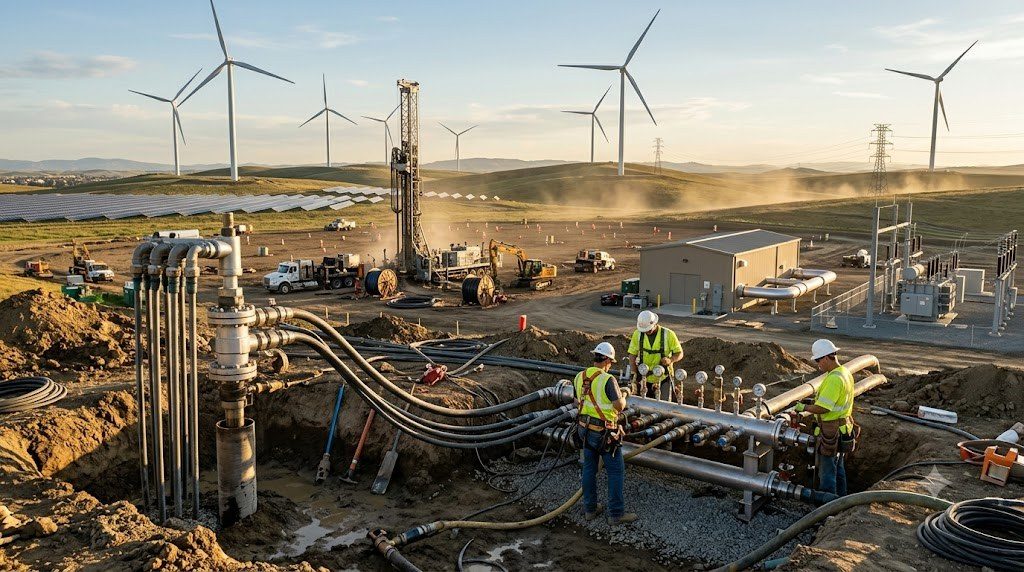
- Vertical Borehole Heat Exchangers (BHE): The industry standard for commercial, institutional, and space-constrained residential installations. A rotary drill rig bores vertical holes (114 to 152 mm diameter) to depths of 100 to 250 meters. A single or double U-tube of HDPE 100-RC pipe equipped with a weighted bottom U-bend shoe is lowered into the hole. The annular space between the pipe and bedrock is backfilled from bottom to top using a tremie pipe with thermally enhanced bentonite grout. Vertical boreholes require minimal land footprint, access deep stable temperatures, and deliver high heat exchange rates (40 to 60 watts per meter of borehole length).
- Horizontal and Slinky Ground Loops: Deployed in suburban or rural settings where land area is abundant and drilling costs are prohibitive. Trenches are excavated 1.5 to 2.2 meters deep using backhoes or trenchers. Coils of overlapping HDPE pipe (resembling an extended slinky toy) are laid flat or vertically along the trench bottom. While capital installation costs are lower (avoiding expensive rock drilling rigs), horizontal loops are subject to seasonal ground temperature swings, require 3 to 5 times more land area, and must be protected from future surface construction or heavy root penetration.
3. In-Situ Thermal Response Testing (TRT) and Borehole Thermal Resistance
Designing a commercial borehole field comprising 50 to 500 boreholes without empirical subsurface data carries immense financial risk. Over-sizing the borehole field inflates capital drilling costs unnecessarily, while under-sizing causes the ground to freeze or overheat over time, collapsing system COP. To prevent this, engineers perform an in-situ Thermal Response Test (TRT) on a pilot test borehole prior to final design.
The TRT apparatus injects a constant thermal heat rate ($q$) into the test borehole over 48 to 72 continuous hours using electric resistance heaters while circulating fluid at a constant flow rate. High-precision platinum resistance temperature detectors (RTD) record the entering and leaving fluid temperatures ($T_{in}, T_{out}$).
The resulting thermal data is evaluated using the Infinite Line Source (ILS) analytical model (formulated by Kelvin and Carslaw & Jaeger):
T_fluid(t) = (q / (4 * pi * k * H)) * ln(t) + [q * R_b / H + (q / (4 * pi * k * H)) * (ln(4 * alpha / r_b^2) - gamma)]
By plotting the average fluid temperature against the natural logarithm of time ($\ln(t)$), the slope of the linear regression line yields the effective subsurface thermal conductivity ($k$) directly, while the intercept determines the effective borehole thermal resistance ($R_b$). Low borehole resistance ($R_b < 0.08 ext{ m-K/W}$) confirms that the grout mixture has no internal voids and provides excellent thermal coupling between the plastic pipe and the surrounding rock mass.
| Subsurface Geological Formation | Typical Thermal Conductivity (k in W/m-K) | Typical Heat Extraction Rate (Watts / meter) | Drilling & Grouting Complexity |
|---|---|---|---|
| Dense Crystalline Granite / Basalt | 3.0 to 3.8 W/m-K | 55 to 75 W/m of vertical borehole | Hard rock rotary percussion air drilling; excellent borehole stability |
| Saturated Quartz Sandstone | 2.8 to 3.5 W/m-K | 50 to 65 W/m | Fast mud-rotary drilling; high groundwater convective enhancement |
| Saturated Dense Limestone / Dolomite | 2.5 to 3.2 W/m-K | 45 to 60 W/m | Karst void risk; requires specialty casing & swelling grouts |
| Saturated Silt / Clay Sediments | 1.5 to 2.2 W/m-K | 35 to 45 W/m | Soft mud drilling; low thermal conductivity; requires longer boreholes |
| Dry Coarse Sand / Gravel Deposits | 0.8 to 1.4 W/m-K | 20 to 30 W/m (Very poor) | High borehole collapse risk; low moisture requires supplemental wetting |
4. Thermal Imbalance and Long-Term Ground Freezing Mitigation
The most insidious long-term operational failure in commercial GSHP installations is ground thermal imbalance. A ground heat exchanger is not an infinite energy source or sink: it is a thermal storage battery that must be balanced over an annual diurnal and seasonal cycle.
In heating-dominated climates (such as Canada, Scandinavia, or the northern United States), buildings extract significantly more thermal energy from the ground in winter than they reject during brief summer air conditioning cycles ($\sum Q_{heat} \gg \sum Q_{cool}$). Over 5 to 15 years of continuous unbalanced operation, heat is extracted faster than the earth’s natural terrestrial heat flux can replenish it. The average ground temperature around the borehole field drops year after year—a phenomenon known as ground thermal depletion or permafrost induction. As ground temperatures drop toward 0°C, the circulation fluid must operate at sub-zero temperatures, causing soil moisture around the boreholes to freeze into ice lenses that heave foundations and collapse heat pump COP.
To ensure 50-year thermal sustainability, engineers deploy hybrid ground-source heat pump (HGSHP) systems:
- Supplemental Solar Thermal / PVT Recharge: In summer and shoulder seasons, unglazed solar thermal collectors or hybrid Photovoltaic-Thermal (PVT) panels harvest excess solar heat and circulate it down into the borehole field, actively recharging the ground temperature back to its native baseline.
- Auxiliary Fluid Coolers and Peaking Boilers: In cooling-dominated climates (where the ground overheats over decades), an open evaporative cooling tower or dry fluid cooler rejects excess heat to the night atmosphere. In heating-dominated climates, a high-efficiency biomass pellet boiler kicks in during extreme sub-zero cold snaps, shaving peak ground extraction loads.
5. Heat Pump Refrigeration Cycles and Coefficient of Performance (COP)
The thermodynamic performance of a ground source heat pump is quantified by its Coefficient of Performance (COP), defined as the ratio of useful thermal heating delivered ($Q_H$) to the electrical compressor energy consumed ($W_{elec}$):
COP_heating = Q_H / W_elec = (Q_ground + W_elec) / W_elec = T_H / (T_H - T_C) * eta_carnot
Where $T_H$ is condensing delivery temperature (Kelvin), $T_C$ is evaporating ground source temperature, and $\eta_{carnot}$ is the second-law compressor efficiency (typically 0.50 to 0.60 for modern scroll compressors).
The mathematical equation reveals the supreme advantage of GSHP: as the evaporating temperature ($T_C$) approaches the condensing temperature ($T_H$), the theoretical Carnot limit approaches infinity. In freezing winter weather when an air-source heat pump must evaporate refrigerant against outdoor air at -15°C ($258 ext{ K}$), a GSHP evaporates against undisturbed ground fluid at +7°C ($280 ext{ K}$). By narrowing the temperature lift by 22°C, the compressor requires 40% to 50% less electrical power to deliver the identical heating output, achieving sustained COPs of 4.5 to 5.2.
Frequently Asked Questions (FAQ) – Ground Source Heat Pumps
Q: How does a ground source heat pump differ from an air-source heat pump?
Air-source heat pumps extract heat from outdoor air, which fluctuates wildly and causes efficiency to plunge during extreme winter freezes. Ground source heat pumps exchange heat with the earth, which stays at a steady 10-15°C year-round.
Q: What does a COP of 4.5 mean?
A Coefficient of Performance (COP) of 4.5 means that for every 1 kilowatt-hour of electricity consumed by the compressor, the heat pump delivers 4.5 kilowatt-hours of useful heat to the building (3.5 kWh drawn free from the ground).
Q: What is the difference between vertical and horizontal ground loops?
Vertical loops drill 100-250m deep holes with small surface footprints and high efficiency. Horizontal loops bury pipes 1.5-2m deep in long trenches, requiring extensive open land but avoiding drilling rig costs.
Q: What is a Thermal Response Test (TRT)?
A TRT is an on-site test on a pilot test borehole where heat is injected into the ground for 48-72 hours to measure the actual thermal conductivity and borehole resistance of the local bedrock.
Q: Why is thermally enhanced bentonite grout necessary in boreholes?
Standard bentonite clay has poor thermal conductivity. Thermally enhanced grout blends graphite or quartz sand to boost heat transfer between the plastic pipes and surrounding rock, preventing air voids.
Q: What causes ground freezing in geothermal heating systems?
In cold climates where buildings extract much more heat in winter than they reject in summer, the ground temperature drops year after year. Eventually the ground freezes, collapsing heat pump efficiency.
Q: How do hybrid GSHP systems prevent ground temperature depletion?
Hybrid systems use solar thermal panels to pump summer heat into the ground to recharge the borehole field, or use auxiliary boilers during extreme winter cold snaps to prevent over-extraction.
Q: Can ground source heat pumps provide 100% passive cooling in summer?
Yes. If the ground is cool enough (10-12°C), water can be circulated directly through the borehole field into radiant ceiling panels or chilled beams, providing free air conditioning with zero compressor power.
Q: What pipe material is used inside geothermal boreholes?
High-Density Polyethylene (HDPE 100-RC) certified for crack resistance and pressure rating PN16 is used, with heat-fused joints that are leak-proof and warrantied for 50+ years.
Q: How close together can geothermal boreholes be drilled?
Boreholes are typically spaced 6 to 8 meters apart in a grid. Spacing them too closely causes adjacent boreholes to thermally interfere and deplete the ground heat prematurely.
Q: What is a 5th-generation district ambient loop (5GDHC)?
A 5GDHC network circulates uninsulated water at near-ground temperatures (10-20°C) across a city district, allowing buildings to share waste heat between heating and cooling users before tapping the ground.
Q: What is the expected lifespan of a geothermal heat pump system?
The underground HDPE borehole loops are engineered to last over 75 to 100 years, while the indoor heat pump mechanical units have a lifespan of 20 to 25 years.
Q: Does shallow geothermal drilling pose any risk to groundwater aquifers?
Boreholes are completely backfilled from bottom to top with impermeable bentonite grout seals, preventing surface contaminants from migrating into drinking water aquifers.